 Arbejdsmarked


Read this article in Danish.
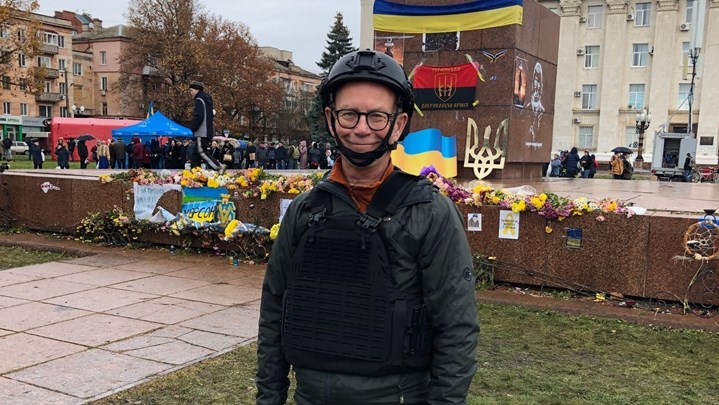
Three years of war has taken its toll on Ukrainians. I feel it clearly in my daily life as a Danish representative in the country. Everyone in my Ukrainian circle of acquaintances has been affected by the war in one way or another.
One of our Ukrainian colleagues at the embassy volunteered immediately after the Russian invasion and has now been in combat for three years.
Others have a brother, spouse or son in the armed forces with no prospect of returning home before the war ends. Many have family in frontline cities like Kharkiv and Zaporizhzhia, where daily aerial bombardments have become a brutal part of everyday life.

But even in the capital Kyiv, the war is a constant presence. Air raid warnings sound around the clock on our mobile phones. Here, the voice of actor Mark Hamill from Star Wars warns: "Air raid alert. Proceed to the nearest shelter. Don't be careless. Your overconfidence is your weakness."
At the embassy, our staff canteen in the basement serves as a shelter where we gather during airstrikes.
Privately, I'm lucky to have access to a basement café in my building where I can take shelter. But most Kyiv residents are forced to either stay in their apartments or seek refuge deep underground in the metro stations.
War takes its toll on everyone
Like the Ukrainians, we have learned to distinguish between the sound of drones that resemble a motorcycle and the sound of missiles that resemble a jet plane.
The air defence systems have their own heavy tonality, while searchlights reach up to the night sky in the dark hours.
Air raid warnings sound around the clock on our mobile phones.
Ole Egberg Mikkelsen
Denmark's ambassador to Ukraine
Despite the effective air defences around Kyiv, missile and drone strikes are still a regular occurrence. The explosions are fierce and can be heard all over the city. Day after day, month after month.
After three years, it has become an everyday occurrence – but it takes its toll on everyone. My Ukrainian colleague Iryna put it succinctly: "I can't cry any more. I have no more tears left."
The losses are staggering, both in human and material terms. In Kyiv, thousands of Ukrainian flags and portrait photos in the informal memorial grove bear witness to the fallen. In cemeteries across the country, there are sections for war graves with flags flying.
So it's no surprise that Ukrainians are tired of war and long for peace. But I don't meet many Ukrainians who talk about making a deal on Russia's terms. All Ukrainians remember the Minsk agreements, which did not bring peace, but uncertainty.
Resilient Ukrainians
Ukrainians are painfully aware of what has happened in the areas under Russian control. The suburb of Bucha, a green and peaceful suburb somewhat reminiscent of Birkerød, 20 kilometres north of Kyiv, was under Russian control in March 2022. Hundreds of the suburb's residents were shot and buried in mass graves.
JYSK has a store in Bucha, which was razed by the occupying forces. But immediately after the city was liberated, JYSK employees set about rebuilding the store.
When I attended the reopening in May 2022, the employees told me that the best thing they could do after four weeks of horror was to return to everyday life.

The indomitable will to restore normality under wartime conditions has left a deep impression on me. In Denmark's partner city, Mykolaiv, just 40 kilometres from the frontline, children still attend choir, ballet and football.
When I visited Kharkiv on a spring day last year, the air raid alarms were so frequent that my colleague Liudmyla and I had to switch off our alarm app. Even so, the city's nursery was full of families with children buying greenery for their gardens.
Denmark plays a very special role
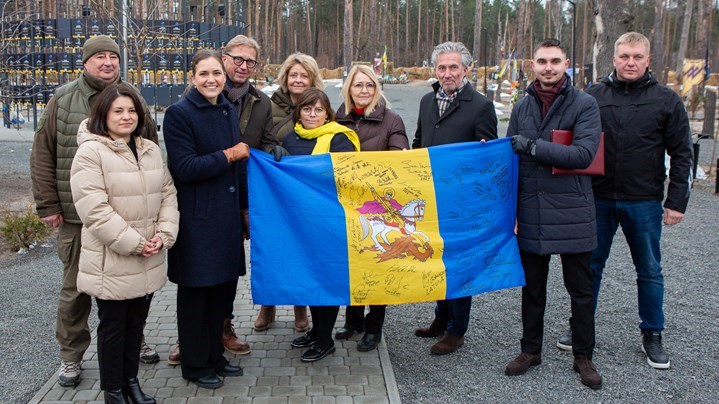
Recently, the Minister for European Affairs, Marie Bjerre, visited us and we arranged a trip to the small community of Moshchun, the centre of fierce fighting during the Battle of Kyiv. Here, Russian forces tried unsuccessfully to secure control of the nearby Hostomel airport and conduct an airdrop and then capture the capital.
The indomitable will to restore normality under wartime conditions has left a deep impression on me.
Ole Egberg Mikkelsen
Denmark's ambassador to Ukraine
We were greeted by the village chairman Vadim, who had led the local residents who had defended the town. Vadim, who was called 'the general', proudly told us that he has three sons at the front – and that he himself is ready to take up arms again if the Russians return.
In the local community centre, the women of the town worked to make emergency rations for the soldiers in the field. As one of them said: "I have to do this – I can't just stay at home while the soldiers are fighting."
Their efforts illustrate very well the will to resist that I still encounter on a daily basis after three years of war.
Denmark plays a very special role in the Ukrainian consciousness. All Ukrainians know that Denmark has been at the forefront from the very beginning, both in military and in civilian support. Many Ukrainians are familiar with the special Danish model for weapons donations, where Denmark finances purchases from Ukrainian manufacturers.
The Danish-Ukrainian partnership with the Mykolaiv region, signed by Prime Minister Mette Frederiksen and President Zelensky in April 2022, is also well known. It has become a symbol that reconstruction cannot wait for peace – it is already underway.
Danish support on many fronts
Denmark provides extensive support to Ukraine's private sector, including in areas near the frontline. Above all, Ukrainians want to earn their own money and avoid dependence on foreign aid.
This is done through the Danish Export and Investment Fund (EIFO) and the Industrialisation Fund for Developing Countries (IFU), both of which have employees at the Danish embassy in Kyiv. Internally they go by the name 'Wall Street', and it has proven to be a great advantage for Danish-Ukrainian co-operation that economic, commercial and diplomatic instruments are gathered in one place.

But it's not just the Danish government that supports Ukraine. Danish citizens independently fundraise and deliver vehicles to Ukrainian armed forces. Private foundations and other organisations are also forming unconventional partnerships to provide support.
For example, with support from Dampskibsselskabet OrientFoundation, Aalborg University and Engineers Without Borders have partnered to help the traditional Shipbuilding University in Mykolaiv, which was damaged by missile strikes in 2022.
Danish municipalities also help municipalities in Ukraine, and Danish civil society organisations are active in both humanitarian aid and reconstruction efforts.
Finally, around 100 Danish companies do business in Ukraine. While the Carlsberg Group is the largest investor, companies of various sizes contribute to Ukraine's economy by maintaining employment, continuing operations, and generating tax revenue.
A hugely meaningful endeavour
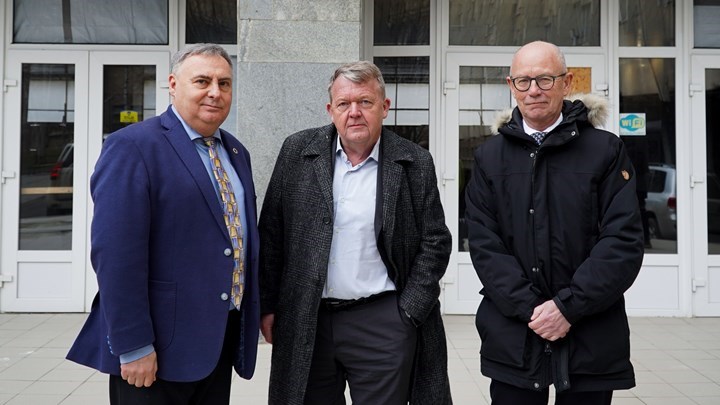
We experience strong and persistent support from both the government and the Danish Parliament. Since 2022, there have been 34 visits by ministers and parliamentary politicians, and each time it strengthens the Danish-Ukrainian partnership.
For Ukrainians, the visits are not only about political dialogue – they also see them as an important declaration of solidarity.
This provides a good basis for fulfilling my role as Denmark's representative here. Of course, due to the war conditions, there are certain challenges.
The 18-hour train journey from Kyiv to Warsaw has long since become routine.
Ole Egberg Mikkelsen
Denmark's ambassador to Ukraine
For example, there is no civilian air traffic in Ukraine, so we travel by train or car through the vast country – or to Poland and Moldova when travelling to Denmark.
After three years, we know most of the motorway cafeterias, where we are always well received. And the 18-hour train journey from Kyiv to Warsaw has long since become routine.
But the work is hugely meaningful. We have a fantastic Danish-Ukrainian team, where everyone works together and makes things work despite a difficult everyday life and a lot of work pressure.
In other words, it's a privilege to be Denmark's representative in Ukraine – both professionally and personally.


'/%3e%3cdefs%3e%3clinearGradient%20id='paint0_linear_26833_4940'%20x1='11.5'%20y1='10.5'%20x2='11.5'%20y2='11.5'%20gradientUnits='userSpaceOnUse'%3e%3cstop%20offset='0.5'%20stop-color='%232C2CA4'/%3e%3cstop%20offset='0.5'%20stop-color='%23E60103'/%3e%3c/linearGradient%3e%3c/defs%3e%3c/svg%3e)


Indsigt


 Fødselsdage
 Jørgen Jelstrup80 år
I dag
 Oberst, fhv. informationschef for Forsvarschefen, fhv. chef for Sergentskolen på Fyn, fhv. chef for Lokalforsvarsregion Fyn, Syd- og Sønderjylland
 Peter Utzon Berg42 år
I dag
Politisk chef, Novo Nordisk, fhv. kontorchef for ministersekretariatet, Statsministeriet H.K.H. Joachim Holger Waldemar Christian57 år
I dag
Prins til Danmark, greve af Monpezat, forsvarsindustriattaché og stedfortrædende forsvarsattaché, Washington D.C.
 Ministersvar
 Sascha Faxe spørger Torsten Schack ElholmHvor er havmiljøberedskabets materiel geografisk placeret?
 Sascha Faxe spørger Lars Løkke RasmussenHvad bliver konsekvenserne, hvis man fra dansk side vælger at opsige baseaftalen med USA?Besvaret
 Lise Bech spørger Torsten Schack ElholmHvorfor indgår afprøvning af ventilation og sandfiltrering ikke i eftersynet af betondækningsgrave?
 Følg lovforslaget
- L 122 Lov om fremme af vedvarende energi med videre (Klima-, Energi- og Forsyningsministeriet)1. behandling
- B 96 Forslag til folketingsbeslutning om en uvildig undersøgelse af politiets rolle og ansvar i forbindelse med Emilie Meng-sagen (Justitsministeriet)Fremsat
- L 109 Lov om forsvarets formål, opgaver og organisation m (Forsvarsministeriet)1. behandling
'%3e%3cpath%20fill-rule='evenodd'%20clip-rule='evenodd'%20d='M4.59974%208.70857L10.9598%2011.4343C11.6239%2011.7189%2012.3756%2011.7189%2013.0397%2011.4343L19.3998%208.70857C20.0699%208.4214%2020.8459%208.7318%2021.133%209.40187C21.2035%209.56618%2021.2398%209.74308%2021.2398%209.92184V18.0592C21.2398%2019.1153%2020.6104%2020.0697%2019.6397%2020.4857L13.0397%2023.3143C12.3756%2023.5989%2011.6239%2023.5989%2010.9598%2023.3143L4.35982%2020.4857C3.38913%2020.0697%202.75977%2019.1153%202.75977%2018.0592V9.92184C2.75977%209.19282%203.35075%208.60184%204.07977%208.60184C4.25853%208.60184%204.43543%208.63815%204.59974%208.70857Z'%20fill='%23EA1718'/%3e%3cpath%20fill-rule='evenodd'%20clip-rule='evenodd'%20d='M12%209.24001C14.1912%209.24001%2015.96%207.47121%2015.96%205.28001C15.96%203.08881%2014.1912%201.32001%2012%201.32001C9.80884%201.32001%208.04004%203.08881%208.04004%205.28001C8.04004%207.47121%209.80884%209.24001%2012%209.24001Z'%20fill='%233340B1'/%3e%3c/g%3e%3cdefs%3e%3cclipPath%20id='clip0_26833_4934'%3e%3crect%20width='24'%20height='24'%20fill='white'/%3e%3c/clipPath%3e%3c/defs%3e%3c/svg%3e) Mest læste Forsvar og Beredskab
Mest læste Forsvar og Beredskab- Kvinderne i overtal for første gang: Se alle de nye ministre
- Syv politikere bliver ministre for første gang: Lær dem at kende her
- Mette Frederiksen danner regering efter rekordforhandlinger. Her er, hvad vi ved
- Her er de nye regeringsudvalg
- Vi vil ikke høre Claude diskutere med ChatGPT. Nu indfører Altinget retningslinjer for debat